About Diocese of Lansing
The Diocese of Lansing (Latin: Diœcesis Lansingensis) is a Roman Catholic diocese in south-central Michigan, erected on May 22, 1937 by Pope Pius XI from territory that had previously belonged to the Archdiocese of Detroit and the Diocese of Grand Rapids. As a suffragan see of the metropolitan Archdiocese of Detroit, it covers 6,218 square miles across ten counties — Clinton, Eaton, Genesee, Hillsdale, Ingham, Jackson, Lenawee, Livingston, Shiawassee, and Washtenaw — including the cities of Lansing, Ann Arbor, Flint, Jackson, Adrian, Owosso and Ypsilanti. Its mother church is St. Mary Cathedral in Lansing, and it is led today by Bishop Earl A. Boyea, Jr. The diocese serves approximately 180,000 Catholics across 72 parishes and operates 32 Catholic schools including four regional high schools.
- Bishop
- Earl A. Boyea, Jr.
- Established
- 1937
- Cathedral
- St. Mary Cathedral, Lansing
- Territory
- Ten counties in south-central Michigan: Clinton, Eaton, Genesee, Hillsdale, Ingham, Jackson, Lenawee, Livingston, Shiawassee, and Washtenaw — covering 6,218 square miles including the cities of Lansing, Ann Arbor, Flint, Jackson, Adrian, Owosso and Ypsilanti.
- Parishes
- 72
- Province
- Archdiocese of Detroit (Ecclesiastical Province of Detroit)
History of the Diocese of Lansing
Erected on May 22, 1937 by Pope Pius XI from territory of the Archdiocese of Detroit (and later adjusted against the Diocese of Grand Rapids and the Diocese of Saginaw), the Diocese of Lansing was created to provide more effective pastoral care in south-central Michigan. The first bishop, Joseph H. Albers, came from the Archdiocese of Cincinnati and was known as 'The Builder' for the dramatic expansion of parishes and schools in the new diocese. He was succeeded in 1965 by Alexander M. Zaleski (formerly an auxiliary of Detroit), in 1975 by Kenneth J. Povish (formerly Bishop of Crookston, Minnesota), in 1996 by Carl F. Mengeling (of the Diocese of Gary, Indiana), and in 2008 by the present Bishop Earl A. Boyea, Jr. Major boundary changes occurred in 1938 (compensation for Saginaw) and 1971 (creation of Kalamazoo and Gaylord), giving the diocese its current ten-county shape.
- Established May 22, 1937 by Pope Pius XI
- First bishop Joseph H. Albers ('The Builder'), 1937–1965
- Second bishop Alexander M. Zaleski, 1965–1975
- Third bishop Kenneth J. Povish, 1975–1995
- Fourth bishop Carl F. Mengeling, 1996–2008
- Fifth bishop Earl A. Boyea, Jr., 2008–present
- Boundary adjustments: 1938, 1971
Office of the Bishop
Bishop Earl A. Boyea, Jr. leads the diocese as its fifth ordinary. Installed April 29, 2008 after his appointment by Pope Benedict XVI, Bishop Boyea previously served as an Auxiliary Bishop of Detroit. His office publishes a regular Beginner's Guide to the diocese, articulates a vision for the rapid evangelization of south-east Michigan, and in 2019 convened a 14-member Strategic Planning Committee to align the diocese's parishes, schools and charities with the missionary call to proclaim the Gospel across the 1.8 million residents of the territory.
- Bishop's office at the chancery: 228 N. Walnut St., Lansing, MI 48933
- Beginner's Guide to the Diocese
- Strategic Planning Committee formed in 2019
- Realignment initiative for parishes and resources
Bishops of Lansing
Five bishops have shepherded the Diocese of Lansing since 1937. The diocese's coat of arms incorporates the cross of the Ingham family (the See City lies in Ingham County), uses the Marian heraldic colors of blue and white, and symbolizes the bishop's readiness to fight for the Faith.
- Joseph H. Albers — 1937–1965 (Founder; Builder)
- Alexander M. Zaleski — 1965–1975
- Kenneth J. Povish — 1975–1995
- Carl F. Mengeling — 1996–2008 (d. 2025)
- Earl A. Boyea, Jr. — 2008–present
St. Mary Cathedral, Lansing
St. Mary Cathedral is the mother church of the Diocese of Lansing. The parish was founded in 1866 when Father Louis Van Driss became Lansing's first resident priest; the present church building was begun in 1911, had its cornerstone laid July 4, 1911 by Bishop Edward D. Kelly, and was dedicated December 8, 1913 under the title 'Immaculate Conception.' Designed by architect Edwyn A. Bowd in a Norman-Gothic Revival style, it seats 1,400 and features stained-glass windows made in Germany and installed in 1923. The Cathedral was added to the National Register of Historic Places in 1990. After Holy Cross Parish closed in 2009 it merged into St. Mary Cathedral, and Fr. Karl Pung was named rector in 2017.
- Cornerstone laid July 4, 1911
- Dedicated December 8, 1913
- National Register of Historic Places (1990)
- 219 Seymour Avenue, Lansing
- Made cathedral of Lansing diocese in 1937
Cathedral Mass Times and Devotions
St. Mary Cathedral publishes a full schedule of Masses and devotions. Saturday Vigil Mass is at 4:00 PM (English); Sunday Masses are at 8:30 AM and 11:00 AM (English). Weekday Masses are celebrated Monday through Friday at 12:05 PM, plus an 8:00 AM Mass on first Fridays and Saturdays. Holy Days follow the weekday schedule: 8:00 AM, 12:05 PM, and 5:15 PM. Devotions include Mother of Perpetual Help Devotions on Tuesdays following the 5:15 PM Mass, followed by St. Anthony Devotions, in the Blessed Sacrament Chapel. Eucharistic Adoration is held on Fridays — Exposition follows the 12:05 PM Mass with Benediction at 5:45 PM — and on the last Wednesday of the month, 7:00–8:00 PM, in the Crypt.
- Saturday Vigil: 4:00 PM (English)
- Sunday: 8:30 AM and 11:00 AM (English)
- Weekday Masses: 12:05 PM Mon–Fri
- First Friday/Saturday: 8:00 AM
- Holy Days: 8:00 AM, 12:05 PM, 5:15 PM
- Mother of Perpetual Help & St. Anthony Devotions — Tuesdays
- Eucharistic Adoration — Fridays after 12:05 PM Mass until Benediction at 5:45 PM
- Welcome Wednesday Adoration — last Wednesday, 7:00–8:00 PM in the Crypt
Catholic Schools of the Diocese
The Diocese of Lansing Catholic Schools system comprises 32 schools serving more than 7,365 elementary and high school students across Ann Arbor, Flint, Jackson, and Lansing. Each of the four regional diocesan high schools — Father Gabriel Richard (Ann Arbor), Powers Catholic (Flint), Lumen Christi (Jackson), and Lansing Catholic — is comprehensive and co-educational, and is grounded in the mission 'That Jesus Christ is the reason for these schools, the unseen but ever-present teacher in all its classes.'
- Fr. Gabriel Richard Catholic High School — Ann Arbor (founded 1868 as St. Thomas the Apostle)
- Powers Catholic High School — Flint (founded 1970)
- Lumen Christi Catholic School — Jackson (founded 1968)
- Lansing Catholic High School — Lansing (consolidated 1970)
- 32 total Catholic schools; 7,365+ students
High Schools — Histories
Each regional high school carries a distinctive heritage. Father Gabriel Richard in Ann Arbor traces its roots to 1868 and was named in 1980 for the missionary priest who established the first Catholic Church in Michigan in 1701. Powers Catholic in Flint relocated in 2015 to the fully renovated former Michigan School for the Deaf and Blind, occupying Fay Hall and a new $15 million addition. Lumen Christi in Jackson, founded 1968, expanded in 2015-16 to include grades 7-8 in a renovated 172,700 sq. ft. facility. Lansing Catholic, formed in 1970, united four earlier schools — St. Mary's (1904), Resurrection (1939), O'Rafferty and Gabriels (both 1963) — and in 2015 opened its St. John Paul II Chapel.
- Fr. Gabriel Richard — moved to Domino's Farms in 2003
- Powers Catholic — Fay Hall renovation 2015
- Lumen Christi — 7–12 since 2015-16
- Lansing Catholic — St. John Paul II Chapel 2015
Catholic Charities of the Diocese
The Department of Catholic Charities coordinates human services across the diocese through regional agencies in Lansing, Flint, Jackson, Ann Arbor and surrounding counties. These agencies provide adoption, foster care, behavioral health, refugee resettlement, domestic violence services, senior services, food assistance and outreach to the poor across all ten counties of the diocese.
- Catholic Charities of Ingham, Eaton and Clinton Counties — Lansing (St. Vincent Campus 2800 W. Willow; Cristo Rey Campus 1717 N. High)
- Catholic Charities of Shiawassee and Genesee Counties — Flint (901 Chippewa St.) and Owosso (120 W. Exchange St.)
- Catholic Charities of Jackson, Lenawee and Hillsdale Counties — Jackson (3425 Francis) and Adrian (199 N. Broad)
- Catholic Charities Washtenaw County — 4925 Packard Rd., Ann Arbor
Faith in Flint
Faith in Flint began in May 2015 as a diocesan initiative launched in conjunction with Faith Catholic during the Flint water crisis to draw attention to the plight of the city and to coordinate Catholic outreach. The initiative unites the Catholic Community of Flint, Christ the King Parish, Our Lady of Guadalupe Parish, St. Francis Prayer Center, Catholic Charities of Shiawassee and Genesee Counties, St. Luke's New Life Center, Powers Catholic High School, and St. John Vianney Catholic School. Its vision is 'Will you be the Catholic presence in Flint…?' — calling Catholics to bring hope through prayer, presence, and service in one of the diocese's most challenged communities.
- Launched May 2015 by Bishop Boyea and Faith Catholic
- Coordinates four Flint parishes and Catholic Charities
- Site: cathedraldioceseoflansing.org / flintcatholic.org
- St. Luke's New Life Center and St. Francis Prayer Center
Parishes and Worship
The diocese's 72 parishes span ten counties and include the cathedral (St. Mary, Lansing), historic Ann Arbor parishes such as St. Andrew (Saline) and St. Francis of Assisi, Flint-area parishes organized as the Catholic Community of Flint, and Jackson-area parishes such as St. John. Masses are offered in English (primary), with Spanish-language outreach through Our Lady of Guadalupe in Flint and a Vietnamese community ministry. Devotions, perpetual Eucharistic Adoration at the Cathedral, and sacramental preparation are provided across the diocese.
- 72 parishes across 10 counties
- St. Mary Cathedral — Lansing
- Holy Cross Parish closed 2009, merged into Cathedral
- Faith communities: English, Spanish, Vietnamese
Diocesan Identity and Coat of Arms
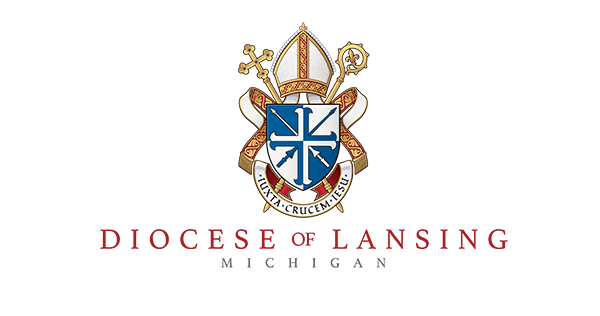
The Diocese of Lansing's coat of arms features the Ingham family cross (because the See City is in Ingham County), uses the Marian colors of blue and white, and carries the heraldic symbolism of a diocese ready to defend the Catholic Faith. Its history page also identifies the cross of the bishop's office as a Diocesan cross adapted to local heritage.
- Ingham family cross incorporated
- Marian colors (blue and white)
- Symbol of the Church Militant