About Diocese of Rapid City
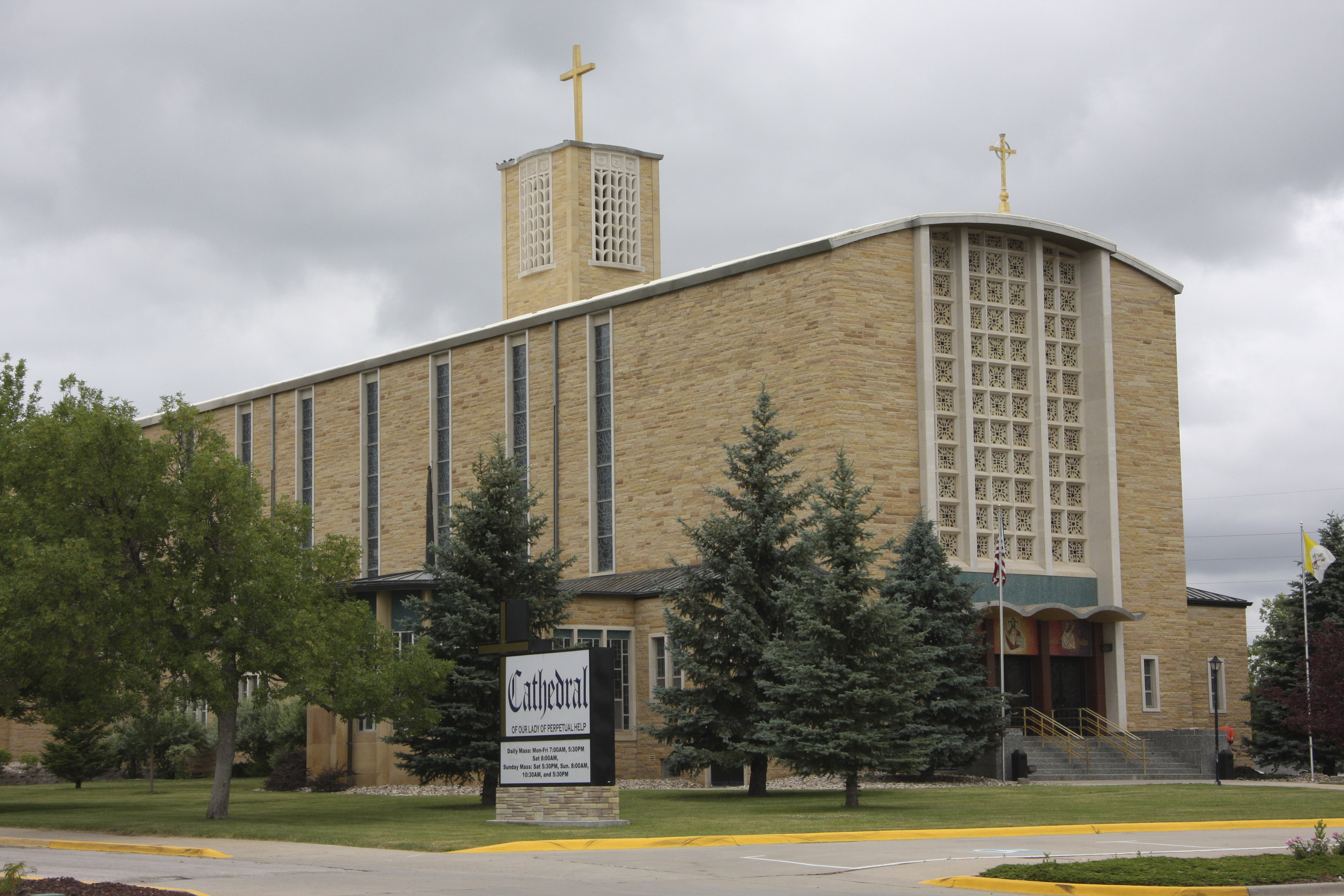
The Diocese of Rapid City (Latin: Dioecesis Rapidopolitana) is a Latin Church diocese of the Catholic Church covering the western 43,000 square miles of South Dakota — the region known as 'West River' — making it one of the largest geographic dioceses in the United States. It is a suffragan of the Archdiocese of Saint Paul and Minneapolis, with its mother church, the Cathedral of Our Lady of Perpetual Help, located in Rapid City. Originally erected in 1902 as the Diocese of Lead and renamed Rapid City in 1930, the diocese is led today by its tenth bishop, Most Rev. Scott E. Bullock (installed September 23, 2024), and is notable for its substantial Native American Catholic population — roughly 27% of Catholics in the diocese — and for housing the canonization cause of Servant of God Nicholas Black Elk, the Lakota catechist.
- Bishop
- Scott E. Bullock
- Established
- 1902
- Cathedral
- Cathedral of Our Lady of Perpetual Help
- Territory
- All of South Dakota west of the Missouri River — the 'West River' region — covering approximately 43,000 square miles (111,327 km²). Includes the Black Hills, Rapid City, and the Pine Ridge, Rosebud, Cheyenne River, and Standing Rock Indian Reservations.
- Parishes
- 72 (as of 2023, per the Official Catholic Directory / Catholic-Hierarchy.org)
- Province
- Archdiocese of Saint Paul and Minneapolis
History of the Diocese of Rapid City
The Diocese of Rapid City traces its origin to August 6, 1902, when Pope Pius X erected the Diocese of Lead out of the western portion of the Diocese of Sioux Falls. Its territory — the entire region of present-day South Dakota west of the Missouri River — had previously belonged to the Diocese of Saint Louis, then Dubuque, then Saint Paul, the Vicariate Apostolic of Dakota, and finally Sioux Falls. Lead, in the heart of the Black Hills gold-mining boom, was selected as the first cathedral city. On August 1, 1930, Pope Pius XI renamed and relocated the see to Rapid City, creating the Diocese of Rapid City as it is known today. The mother church, the Cathedral of Our Lady of Perpetual Help, was built in 1960–1962 and dedicated in 1963 to replace the earlier Cathedral of the Immaculate Conception. The diocese is suffragan to the Archdiocese of Saint Paul and Minneapolis and covers roughly 43,000 square miles.
- 1902: Erected as Diocese of Lead by Pope Pius X
- 1930: Renamed Diocese of Rapid City by Pope Pius XI
- 1963: Cathedral of Our Lady of Perpetual Help dedicated
- Suffragan of the Archdiocese of Saint Paul and Minneapolis
Bishops of Rapid City
Ten bishops have shepherded the diocese since 1902, beginning with John Stariha, the founding bishop of Lead. Two of the diocese's bishops — Charles J. Chaput (bishop 1988–1997) and Blase J. Cupich (bishop 1997–2010) — went on to become cardinals, an unusual concentration of future cardinals for a small, rural diocese. The present bishop, the tenth, is Scott E. Bullock, a former engineer and longtime priest of the Archdiocese of Dubuque, installed September 23, 2024. The see was vacant from February 17, 2024, the death of Bishop Peter Michael Muhich, until Bullock's installation.
- John Stariha (1902–1909)
- Joseph Busch (1910–1915)
- John J. Lawler (1916–1948)
- William T. McCarty, C.Ss.R. (1948–1969)
- Harold Dimmerling (1969–1987)
- Charles J. Chaput, O.F.M. Cap. (1988–1997) — later Cardinal
- Blase J. Cupich (1997–2010) — later Cardinal
- Robert D. Gruss (2011–2019)
- Peter Michael Muhich (2020–2024)
- Scott E. Bullock (2024–present)
Cathedral of Our Lady of Perpetual Help
The Cathedral of Our Lady of Perpetual Help, located at 520 Cathedral Drive, Rapid City, is the third cathedral of the diocese, designed by Rapid City architect Adrian L. Forrette and built by Brezina Construction. Groundbreaking was held in 1960; the church was completed in 1962 and formally dedicated on May 7, 1963 by Apostolic Delegate Archbishop Egidio Vagnozzi. The Mid-century modern building is faced in Mankato stone and trimmed in Indiana limestone, with Cold Spring granite steps, an 18-foot cross atop a 107-foot bell tower, a 235-foot barrel-vaulted nave, eighteen tall stained-glass windows, Italian marbles, a large icon of Our Lady of Perpetual Help above the marble altar, and a hand-carved walnut cathedra. Capacity is 1,000. A larger pipe organ was installed in the rear gallery in 1983, the carillon was computerized in 2012, and a 12,000-square-foot parish hall/classroom/meeting addition was completed in 2024 on the south side.
- Address: 520 Cathedral Drive, Rapid City, SD 57701
- Phone: (605) 342-0507
- Architect: Adrian L. Forrette (Ewing & Forrette)
- Weekend Masses: Saturday 5:30 PM; Sunday 8:00, 10:30, 5:30
- Perpetual Adoration Chapel on site
Faith Formation & Religious Education
The Office of Faith Formation directs evangelization, catechesis, and discipleship formation across the diocese under its mission to form disciples in the image of Christ. The office publishes K-12 religion curriculum standards (K-8 promulgated spring 2024 under Bishop Peter Muhich; high school standards added February 2026 under Bishop Scott Bullock) and runs a wide array of formation programs for parish catechists, lay ecclesial ministers, clergy, and youth.
- Veritatis Splendor Institute (VSI) — yearlong basic certification, monthly Saturdays
- Franciscan Catechetical Institute — summer online courses
- Certified Lay Ecclesial Ministry (CLEM) — three-year formation program at Terra Sancta Retreat Center
- Cor ad Cor — yearlong Ignatian small-group retreat
- Vita Christi Retreats and Refuel Retreat for ministry leaders
- Deanery Days — local formation delivered regionally
- Pastoral Ministry Days — annual diocesan gathering
Native American Ministry & Black Elk Cause
Roughly 27% of the Catholics in the Diocese of Rapid City are Native American — a concentration unmatched in most U.S. dioceses. The Office of Native Ministry serves as liaison between the Native community and the diocese and collaborates with the staff of the Sioux Spiritual Center / Heḣaka Sapa (Black Elk Catholic Retreat Center) on the Cheyenne River Reservation. Programs include Lakota catechist formation, the Canku Wakan ('Holy Road') four-day inculturated retreat, the Basic Directions in Native American Ministry Institute (the only program of its kind in the U.S.), and the Fostering Native Youth Leadership program.
- Office of Native Ministry
- Sioux Spiritual Center / Heḣaka Sapa Black Elk Catholic Retreat Center
- Canku Wakan (Holy Road) inculturated retreat
- Basic Directions in Native American Ministry Institute
- Lakota Inculturation Task Force (est. 1994) and 1999 'Recommendations for Inculturation of Lakota Catholicism'
- Sweat lodge (Inipi), sacred pipe, and talking circle integrated with Eucharist
Cause for the Canonization of Nicholas Black Elk
On March 14, 2016, the Black Elk family presented Bishop Robert D. Gruss with a petition of more than 1,600 signatures asking him to open the cause for canonization of Nicholas W. Black Elk, Sr. (1863–1950), the Oglala Lakota catechist credited with bringing more than 400 Native Americans into the Catholic Church. Bishop Gruss formally opened the cause on October 21, 2017 at Holy Rosary Church on the Pine Ridge Reservation. The diocesan inquiry concluded at a Mass on June 25, 2019 at St. Agnes Church, Manderson, with Bishop Gruss sealing the documents in a red cord to be sent to the Congregation for the Causes of Saints in Rome. In November 2019 the U.S. Conference of Catholic Bishops approved the canonical consultation by voice vote. Black Elk is currently titled 'Servant of God'; if a miracle is approved he could become the first male Native American canonized saint from the United States.
- Born c. 1863, Oglala Lakota, into a family of medicine men
- Baptized December 6, 1904, feast of St. Nicholas, at Holy Rosary Mission, Pine Ridge
- Jesuits appointed him catechist in 1907
- Credited with 400+ baptisms across reservations
- Died August 17, 1950 at Pine Ridge
- Cause opened October 21, 2017; diocesan phase closed June 25, 2019
- USCCB canonical consultation approved November 2019
Catholic Schools in the Diocese
The Rapid City Catholic School System (RCCSS), restructured in 1983 into a single interparish system, is the educational arm of the diocese and is accredited by NCEA. It comprises three schools on two campuses: the Main Campus at 300 Fairmont Boulevard, home to St. Thomas More High School (grades 9–12) and St. Thomas More Middle School (grades 6–8, established 2012 in the former Seton Elementary building); and the Terra Sancta Campus, home to St. Elizabeth Ann Seton Elementary (K–5, dedicated 2012) and St. Elizabeth Seton Preschool. The Rapid City Catholic School System is anchored in the tradition of St. Elizabeth Ann Seton and St. Thomas More and is dedicated to spiritual formation, academic excellence, and service.
- St. Thomas More High School — 300 Fairmont Blvd, Rapid City
- St. Thomas More Middle School — 424 Fairmont Blvd, Rapid City
- St. Elizabeth Ann Seton Elementary — Terra Sancta Campus
- St. Elizabeth Seton Preschool — 2101 City Springs Road, Suite 100
- RCCSS main office: (605) 348-1477
Parishes and Vicariates
The diocese is home to 72 parishes (2023) clustered into vicariates across western South Dakota, from the Black Hills to the reservations. A parish finder on the diocesan website allows searches by city, parish name, or pastor; a vicariate map is also published online. Parishes are ministered to by a small but dedicated presbyterate: in 2023 the diocese had roughly 50 active priests (38 diocesan, 12 religious) serving 23,668 Catholics across 43,000 square miles, with 32 permanent deacons assisting.
- Parish finder at rapidcitydiocese.org/parishes
- Vicariate map published online
- 72 parishes, 32 permanent deacons (2023)
Retreat Centers: Terra Sancta and Sioux Spiritual Center
Two retreat centers anchor the spiritual life of the diocese. Terra Sancta Retreat Center, dedicated May 10, 2012, sits on 200 acres west of Rapid City purchased from the Benedictines in 2007, and hosts the CLEM formation year, parish missions, and other diocesan retreats. The Sioux Spiritual Center — now the Heḣaka Sapa Black Elk Catholic Retreat Center — sits in the breaks of the Cheyenne River in western South Dakota and is a house of prayer specifically for Native people. It is governed by a twelve-member Board of Directors (majority Native American) chaired by Bishop Scott Bullock, and is jointly maintained by the diocese and the Wisconsin Province of the Society of Jesus (Jesuits).
- Terra Sancta Retreat Center — Rapid City area, dedicated 2012
- Heḣaka Sapa / Black Elk Catholic Retreat Center (Sioux Spiritual Center) — Cheyenne River
- Hosts CLEM year, parish retreats, Native youth leadership formation, and Canku Wakan retreats
West River Catholic & Communications
The diocese publishes West River Catholic, the official diocesan newspaper founded by Bishop Harold Dimmerling in the 1970s. The diocesan website (rapidcitydiocese.org) also publishes regular news, a monthly Faith Formation reflection newsletter, and digital newsletters including 'The Morning' for youth and young adults, plus 'Cinema with the Shepherd' and other bishop-led events.
- West River Catholic newspaper
- Monthly Faith Formation reflection newsletter
- 'The Morning' digital newsletter for youth and young adults
- Cinema with the Shepherd film series hosted by Bishop Bullock